
How Deep Should a Water Line Be Buried in Tennessee?
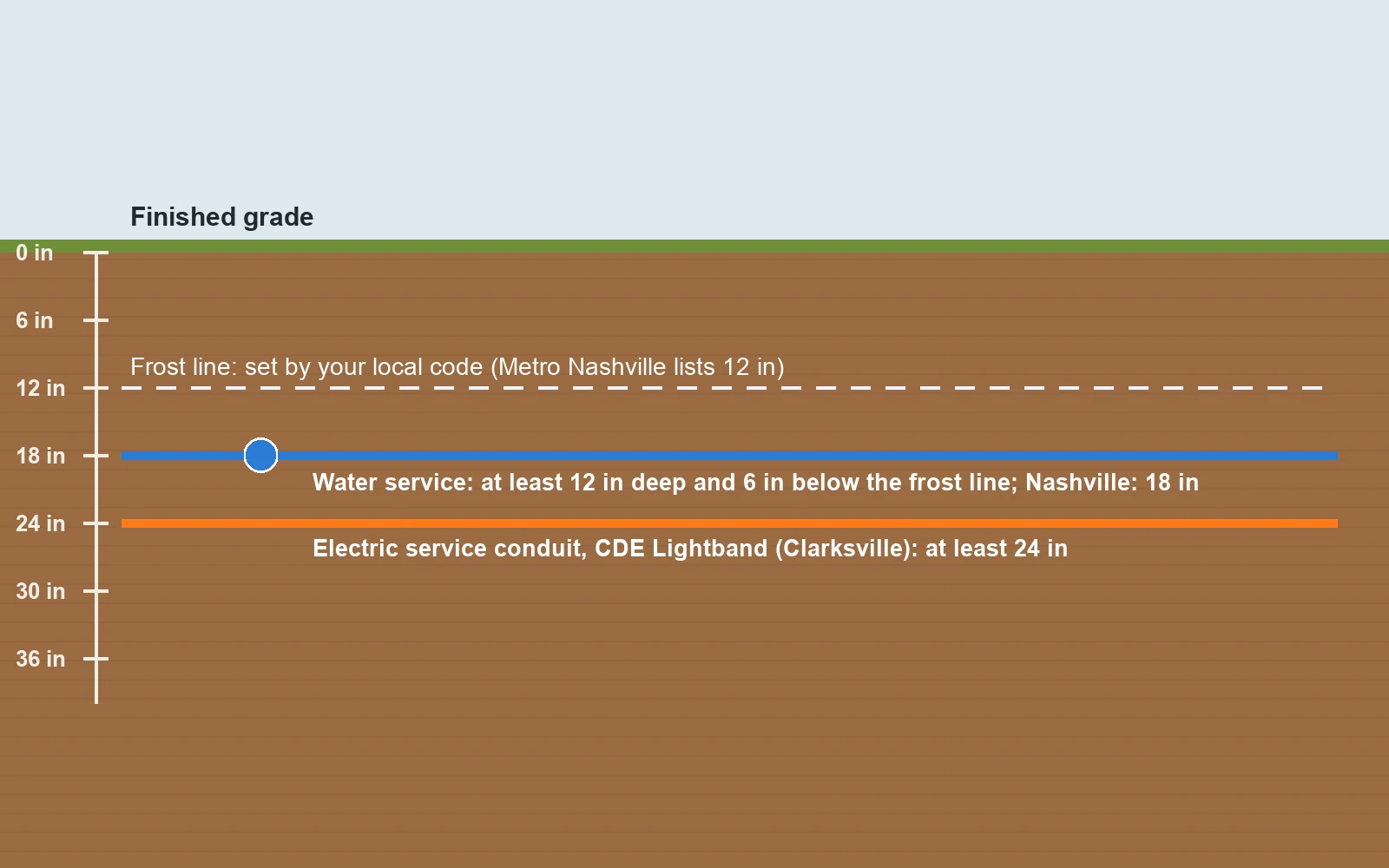
By code, a water line in Tennessee goes at least 12 inches deep. It also has to sit at least 6 inches below the frost line. Both rules are in the Tennessee edition of the 2018 International Residential Code, or IRC. Metro Nashville’s amended code sets 18 inches below finished grade instead, measured to the top of the pipe.
In Clarksville, the water utility has its own number too. For a 5/8 to 1 inch meter, Clarksville Gas and Water wants the service 18 to 24 inches deep. That is measured from the top of the line to the top of the meter box. We dig, bed and backfill that trench as part of our water line trenching service.
How deep is a water line buried around Clarksville and Nashville?
Each depth below comes from a published code or utility standard. Check which ones cover your lot before the trench is dug.
| Source | Line | Depth |
|---|---|---|
| Tennessee edition, 2018 IRC | Water service pipe | 12 inches deep and 6 inches below the frost line |
| Metro Nashville amended code | Water service pipe | 18 inches below finished grade, to the top of the pipe |
| Clarksville Gas and Water | Service at a 5/8 to 1 inch meter | 18 to 24 inches, top of line to top of meter box |
| Clarksville Gas and Water | Water mains | 36 inches of cover, 48 inches under traffic |
| CDE Lightband, Clarksville | Electric service conduit | 24 inches below final grade |
| Metro Nashville amended code | Building sewer | 12 inches below grade |
National guides give a looser answer. Fixr says a water main is buried 1 to 3 feet deep in most areas. In Tennessee, build to the local code and the local utility.
What is the frost line in Tennessee?
There is no single statewide frost line. The code leaves that number for each jurisdiction to fill in, in Table R301.2(1). The number it asks for is the minimum depth of a footing below finish grade.
Metro Nashville’s design table lists a 12 inch frost line. With that number, the state rule puts a water line at least 18 inches down. Nashville’s own amended rule also lands on 18 inches.
Montgomery County enforces the 2018 International Residential Code, effective January 1, 2021. So for a county lot, the frost depth comes from the building department. Montgomery County Building and Codes is at 931-648-5718. Code editions differ too, and White Bluff builds under the 2021 International Residential Code.
That makes the frost line a footing question too. Our guide to footers for a house in Tennessee covers that side of the dig.
Why does Clarksville want water lines sleeved at the footing?
On July 26, 2023, Clarksville’s Building and Codes Department sent builders a memo. It pointed to “the recurring problem of waterline depth.” Since August 1, 2023, waterlines must be sleeved at or under the footing at the footing inspection.
So the sleeve has to be in place when the footing gets inspected. That puts the water line on the same schedule as the foundation excavation.
What are the trench rules for a water line?
The first six rules come from the state code. Local codes and utilities can add their own.
- The pipe needs solid, continuous support between joints. It never rests on rocks or blocks.
- Rocky or unstable ground gets dug two or more pipe diameters deeper. Compacted granular material brings it back to grade.
- Backfill stays free of rocks, broken concrete and frozen chunks until 12 inches of tamped earth covers the pipe.
- Backfill goes in evenly on both sides of the pipe. Loose earth goes back in 6 inch layers, tamped in place.
- A trench alongside a footing stays out of the footing’s bearing plane. That plane runs down at 45 degrees from the footing’s outside bottom edge.
- The water service and the building sewer stay 5 feet apart, with undisturbed or compacted earth between them. A sewer pipe of a listed material can share the trench.
- Tennessee 811 gets notice at least 3 and not more than 10 working days before digging. The line markings are free.
- Clarksville Gas and Water’s specs want a way out of any trench 4 feet or deeper. HomeGuide notes that 5 feet or deeper needs shoring or another protective system.
Does the depth count from today’s ground or the final grade?
Several of these rules count from the final ground level. Nashville measures from finished grade to the top of the pipe. CDE Lightband measures its conduit depth from final grade.
If the trench goes in before final grade, figure the depth from the planned final grade. A line under a high spot that gets cut down later can end up short of cover. Site prep and grading sets those final elevations.
How deep do you bury electrical conduit?
In Clarksville, CDE Lightband sets the rules for a new home’s underground electric service. The conduit sits at least 24 inches below final grade. Plastic warning tape goes in 12 inches above the conduit during backfill. Large rocks stay out of the backfill within 6 inches of it.
CDE is consulted first to set the meter location and the route. The City of Clarksville electrical inspector approves the conduit before the trench is backfilled. Outside CDE’s area, ask your power company and electrician for the depth.
CDE’s policy puts all the ditching and backfilling on the property owner or developer. That is the part we do, and an electrician makes the power connections.
How deep does a sewer or septic line go?
Nashville’s amended code puts building sewers at least 12 inches below grade. A sewer that connects to a septic tank sits at least 12 inches below finished grade at the tank. The state edition prints those two sewer depths as blanks for local codes to fill.
We dig and backfill the trench for sewer and septic lines. A licensed installer sets the septic system itself.
What does it cost to bury a water line?
The ranges below are national market numbers from two cost guides, HomeGuide and Fixr. These are market numbers, not our price list. Each row comes from one guide, and the two guides land far apart.
| What it covers | National range | Guide |
|---|---|---|
| Trenching only, per linear foot | $5 to $12 | HomeGuide |
| Trenching labor | $35 to $65 an hour | HomeGuide |
| Water line, per linear foot installed | $30 to $50 | HomeGuide |
| Water line, whole job installed | $800 to $3,000 | HomeGuide |
| New water line trenched in, meter connection included | $1,700 to $3,000 | HomeGuide |
| Type K copper water line, per foot installed | $11 to $23 | HomeGuide |
| Half inch PVC electrical conduit, per foot installed | $6.00 to $13.50 | HomeGuide |
| Main water line, per linear foot | $75 to $225 | Fixr |
| Main water line by open trench, labor included, per linear foot | $175 to $225 | Fixr |
| Main water line, whole job | $1,500 to $12,000 | Fixr |
HomeGuide notes that trenching costs more in hard clay or rocky soil. Fixr says most people pay $100 to $200 a linear foot for a main water line. The length of the run and the ground it crosses drive the price.
Who digs the water line trench near Clarksville?
Trenching for water lines and conduit is part of our work out of Woodlawn, just west of Clarksville. We dig, bed and backfill the trench to the depth your code and utility call for. A licensed plumber makes the water connections, and an electrician makes the power connections.
Clarksville and Montgomery County are home ground, and we travel to Nashville and Franklin. Estimates are free, so call or text (931) 572-8673.